
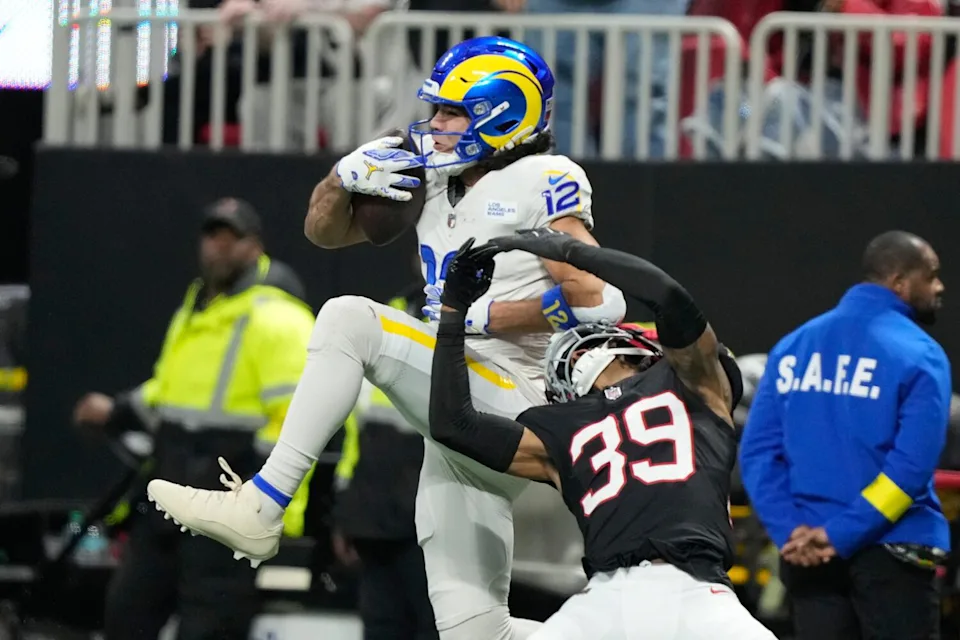
The Rams got exactly what they wanted: a playoff spot.
The problem is how they got there.
Los Angeles is heading into the postseason looking nothing like a contender, and Monday night’s 27–24 loss to the Atlanta Falcons was the clearest warning sign yet. The defeat wasn’t just disappointing — it was alarming — and the mood afterward reflected that reality. This is a game the Rams can’t simply move past. They need to dissect it, no matter how uncomfortable that process becomes.
“If we come out and play like we did in the first half, we’ll be sitting at home watching the playoffs instead of playing in them,” defensive tackle Kobie Turner admitted. “We have to fix this.”
The numbers alone tell a troubling story. It was only the third time in Sean McVay’s nine-year tenure that his team failed to score a single point in the first half. Worse still, a Falcons team that had recently dropped seven of eight games built a 21-point halftime lead with ease.
This didn’t resemble the Rams squad that spent much of the season perched atop power rankings. Matthew Stafford threw three interceptions. Backup left tackle D.J. Humphries committed two costly penalties that erased big plays. And Bijan Robinson gashed the defense so badly that his 93-yard touchdown run felt endless.
The confident group that started the season 9–2 now feels distant. Since then, Los Angeles has dropped three of its last five games, momentum leaking away at the worst possible time.
Meanwhile, the rest of the NFC is surging. Seattle, San Francisco, Philadelphia, and Chicago are all peaking, while the Rams appear to be going the opposite direction — cooling off just as the playoff race intensifies.
That reality turns Sunday’s finale against Arizona into a must-use tune-up rather than a formality. The Rams can’t afford to stumble into the postseason hoping things magically click. Adjustments must happen now.
Getting Davante Adams back would help. He looked explosive in pregame warmups, suggesting the hamstring issue may finally be behind him. His presence in the red zone is badly needed and would ease the burden on Puka Nacua.
The offensive line situation is just as critical. The expected returns of left tackle Alaric Jackson and right guard Kevin Dotson could stabilize a unit that’s been forced into constant reshuffling — a problem that’s plagued the Chargers all season.
On defense, Quentin Lake’s return should provide a boost. His communication and awareness act as a steadying force for the entire unit.
Still, championship-caliber teams find ways to win despite injuries. Depth matters in January, and excuses don’t carry much weight.
Yes, the Rams had chances late. A potential pass interference on Tutu Atwell went uncalled, denying Los Angeles a possible tying field goal attempt. But they never should have been in that position to begin with.
Atlanta, meanwhile, nearly unraveled, outscored 24–6 in the second half and surely reliving memories of its infamous Super Bowl collapse. But unlike that night, the Falcons held on.
For the Rams, it was another gut punch. After blowing a 16-point fourth-quarter lead in Seattle the week before, this was supposed to be a response game. Instead, it became a reminder of their fragility.
History offers little comfort. It’s exceedingly rare for a team to stumble into the playoffs and still win it all. The last to do so was Baltimore in 2012 — a Ravens team that limped through the finish line before embarking on a legendary postseason run.
So yes, it’s possible. Struggling teams can rediscover themselves.
There were even flashes of hope Monday night. Rookie Jared Verse blocked a Falcons field goal, scooped up the loose ball, and returned it 76 yards for a touchdown — a spark that briefly suggested a turning point.
But unless something changes fast, that moment may serve as irony rather than inspiration.
Because right now, instead of fearing the Rams, the rest of the playoff field may be waving them on — confident that Los Angeles is limping, not charging, into January.